Why a Fractional CMO Beats a Full-Time Hire for Most Growing Brands
14 minute read
14 minute read
Danielle Russell
•
Strategy

Why a Fractional CMO Beats a Full-Time Hire for Most Growing Brands
Why a Fractional CMO Beats a Full-Time Hire for Most Growing Brands
Marketing leadership is one of the hardest roles in a company to get right, and one of the most expensive to get wrong. Hire too early and you're paying six figures for a strategy you're not ready to execute. Hire too late and every campaign is a guess. That's why more growing brands are skipping the full-time hire altogether and bringing in a fractional CMO instead.
Here's what that actually means, why the numbers back it up, and how to tell if it's the right move for you.
The full-time CMO gamble
Hiring a full-time Chief Marketing Officer is a long bet. It takes months to recruit, longer to onboard, and even longer for their strategy to show real results. The problem is that most CMOs don't stay long enough to see it through.
Spencer Stuart's 2024 CMO Tenure Study found the average Fortune 500 CMO lasted just 4.2 years in the role in 2023, shorter than the 4.6-year average across every other C-suite function. That's not much time to learn the business, build a team, launch a strategy, and prove it worked, before the clock resets and the next search begins.

A fractional CMO removes that timeline risk. You get senior-level strategy on a flexible schedule, without staking a year of runway and a six-figure salary on whether one hire works out.
The budget math has changed
Marketing budgets aren't growing the way they used to. Gartner's 2025 CMO Spend Survey found that marketing budgets have flatlined at 7.7% of overall company revenue, the lowest level in years. Companies are being asked to do more with the same dollars, or less.
That squeeze makes a six-figure full-time salary, plus benefits, plus the cost of a mis-hire, a much harder number to justify. A fractional CMO puts senior strategy back within reach.
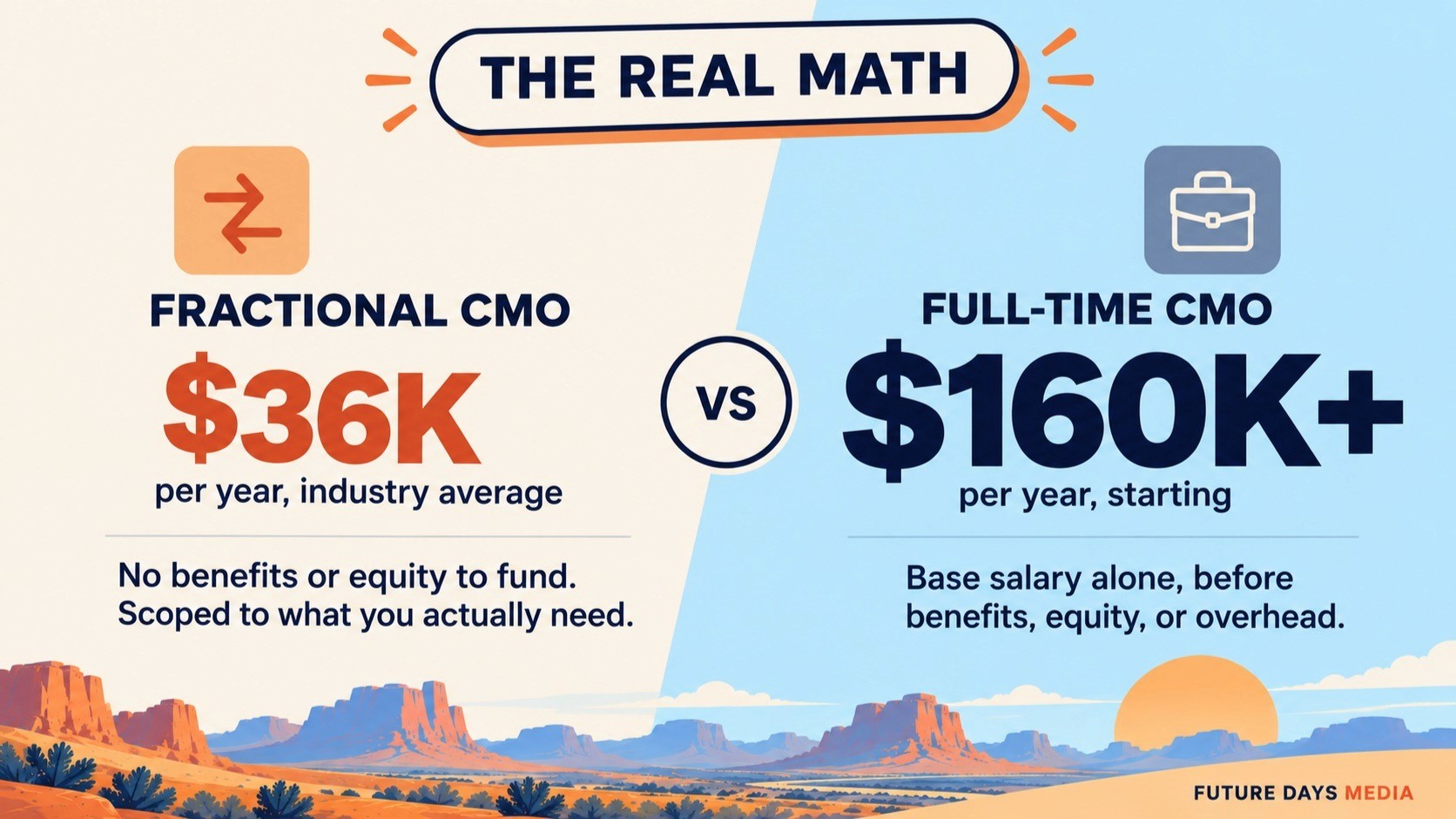
A 2021 Forbes Communications Council breakdown put the typical fractional CMO engagement at around $36,000 a year, against a full-time CMO salary that starts around $160,000, before benefits, equity, or overhead. That's the industry benchmark. Future Days Media's own packages are built to come in below it. Same seat at the table, a fraction of the cost, at a rate scoped to your budget, not just the national average.
What you actually get
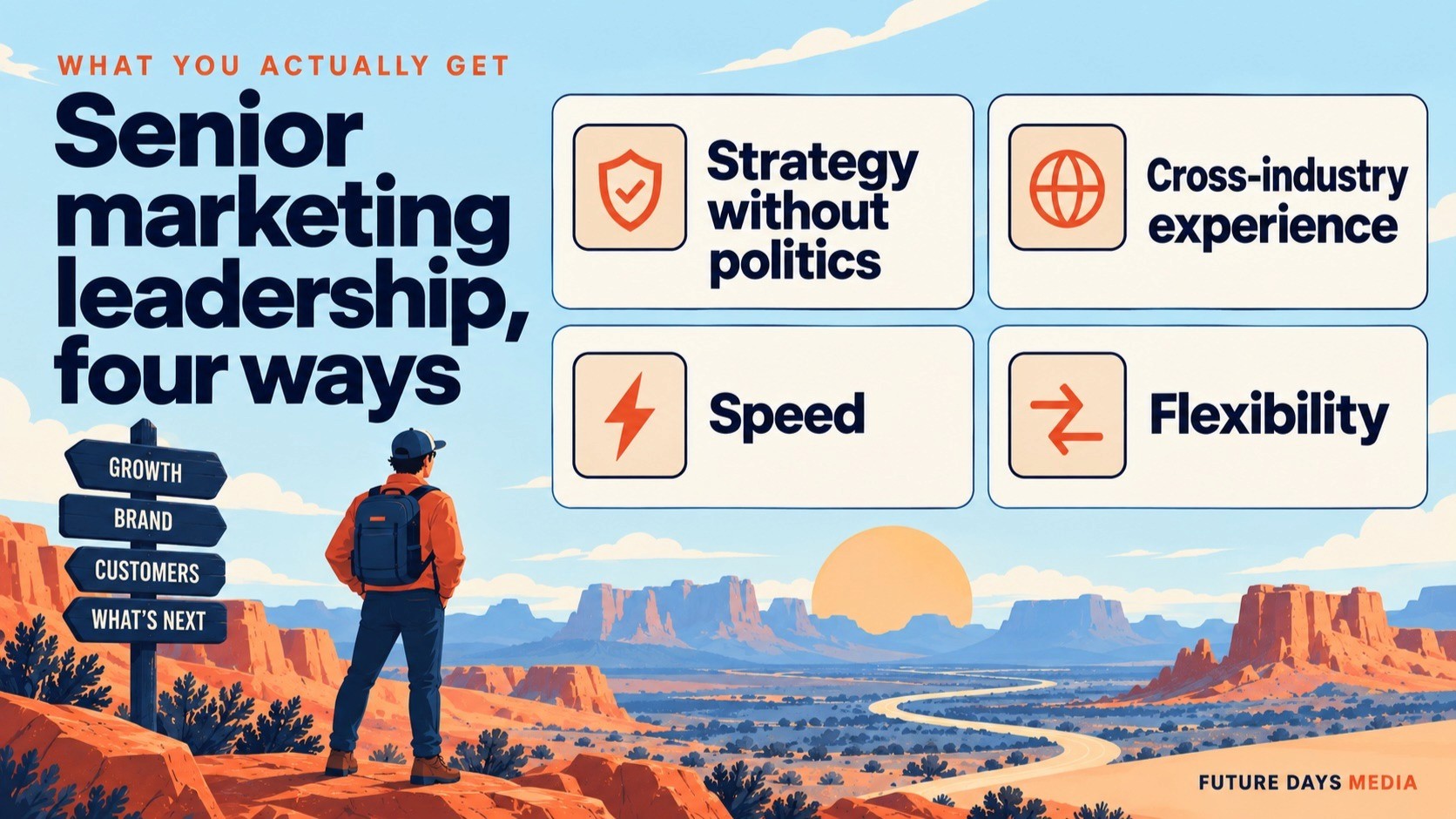
A fractional CMO isn't a scaled-down version of a full-time one. It's also a different kind of engagement than marketing consulting, which is built to deliver a plan or move a specific project forward. A fractional CMO stays embedded as ongoing leadership, accountable for the results over time, the same way a full-time executive would, just on a schedule sized to what you actually need. In practice, that looks like:
Strategy without the politics. A fractional CMO's job is to give you honest guidance and get results, not manage internal turf or protect a title.
Experience across industries. Most have led marketing for multiple companies, so they've already seen what works and what doesn't in your category, before they ever touch your budget.
Speed. No six-month executive search. A fractional CMO can start assessing your marketing within weeks, not quarters.
Flexibility. Scale the engagement up during a launch or a rebrand, and back down during a quiet quarter. You're not locked into a fixed headcount either way.
How the engagement actually works
Most fractional CMO relationships start the same way: an audit. Before anyone sets strategy, a fractional CMO needs to see what's actually happening across your website, social channels, email, and paid spend, and where the gaps are. From there, the engagement usually settles into a regular cadence, often weekly or biweekly, built around a handful of priorities rather than a long list of everything at once.
That's a different rhythm than a full-time hire, who's expected to own every marketing function from day one. A fractional CMO is brought in to fix or build specific things, then keep them running. It's a narrower scope, but it's the scope most growing companies actually need.
Signs it's time to consider one
A fractional CMO tends to make the most sense when:
Marketing is being run by a founder, ops lead, or whoever has time, not a marketer
You have budget for tactics like ads, content, and social, but no one setting the strategy those tactics should serve
You need senior-level thinking now, but not a $160,000-plus salary line
You're scaling fast and can't wait through a months-long executive search
You have some in-house marketing talent, but lack senior strategic direction
If a few of those sound familiar, honestly, that's usually the point where a fractional CMO pays for itself the fastest.
This isn't just a startup move
Fractional CMOs get talked about mostly in the startup world, but the model fits established small and mid-sized businesses just as well, sometimes better. A local business with 5-10 years of loyal customers and a website that hasn't caught up doesn't need a full department. It needs someone senior enough to spot the gaps between the website, the social channels, the reviews, and the brand story, and build a plan to close them.
That's a strategy problem, not a headcount problem. It's exactly the kind of work a fractional CMO is built to do.
What this means for you
You don't have to choose between "no marketing leadership" and "a full-time CMO you're not ready to hire." A fractional CMO gets you real strategy, real experience, and real accountability, on a schedule and budget that actually fits where your business is right now.
At Future Days Media, our fractional CMO packages are built around exactly this: senior marketing leadership, scoped to what your business needs today, not a one-size-fits-all retainer. Contact us to learn more about our packages and find the right fit for your brand.
SOURCES CITED
1. Spencer Stuart, "CMO Tenure Study 2024: An Expanded View of CMO Tenure and Background" — spencerstuart.com/research-and-insight/cmo-tenure-study-2024-an-expanded-view-of-cmo-tenure-and-background
2. Gartner, "2025 CMO Spend Survey Reveals Marketing Budgets Have Flatlined at 7.7% of Overall Company Revenue" (May 2025) — gartner.com/en/newsroom/press-releases/2025-05-12-gartner-2025-cmo-spend-survey-reveals-marketing-budgets-have-flatlined-at-seven-percent-of-overall-company-revenue
3. Forbes Communications Council, "The Benefits Of Hiring A Fractional CMO (And How To Choose One)" (Dec 2021) — forbes.com/councils/forbescommunicationscouncil/2021/12/28/the-benefits-of-hiring-a-fractional-cmo-and-how-to-choose-one
Marketing leadership is one of the hardest roles in a company to get right, and one of the most expensive to get wrong. Hire too early and you're paying six figures for a strategy you're not ready to execute. Hire too late and every campaign is a guess. That's why more growing brands are skipping the full-time hire altogether and bringing in a fractional CMO instead.
Here's what that actually means, why the numbers back it up, and how to tell if it's the right move for you.
The full-time CMO gamble
Hiring a full-time Chief Marketing Officer is a long bet. It takes months to recruit, longer to onboard, and even longer for their strategy to show real results. The problem is that most CMOs don't stay long enough to see it through.
Spencer Stuart's 2024 CMO Tenure Study found the average Fortune 500 CMO lasted just 4.2 years in the role in 2023, shorter than the 4.6-year average across every other C-suite function. That's not much time to learn the business, build a team, launch a strategy, and prove it worked, before the clock resets and the next search begins.
A fractional CMO removes that timeline risk. You get senior-level strategy on a flexible schedule, without staking a year of runway and a six-figure salary on whether one hire works out.
The budget math has changed
Marketing budgets aren't growing the way they used to. Gartner's 2025 CMO Spend Survey found that marketing budgets have flatlined at 7.7% of overall company revenue, the lowest level in years. Companies are being asked to do more with the same dollars, or less.
That squeeze makes a six-figure full-time salary, plus benefits, plus the cost of a mis-hire, a much harder number to justify. A fractional CMO puts senior strategy back within reach.
A 2021 Forbes Communications Council breakdown put the typical fractional CMO engagement at around $36,000 a year, against a full-time CMO salary that starts around $160,000, before benefits, equity, or overhead. That's the industry benchmark. Future Days Media's own packages are built to come in below it. Same seat at the table, a fraction of the cost, at a rate scoped to your budget, not just the national average.
What you actually get
A fractional CMO isn't a scaled-down version of a full-time one. It's also a different kind of engagement than marketing consulting, which is built to deliver a plan or move a specific project forward. A fractional CMO stays embedded as ongoing leadership, accountable for the results over time, the same way a full-time executive would, just on a schedule sized to what you actually need. In practice, that looks like:
Strategy without the politics. A fractional CMO's job is to give you honest guidance and get results, not manage internal turf or protect a title.
Experience across industries. Most have led marketing for multiple companies, so they've already seen what works and what doesn't in your category, before they ever touch your budget.
Speed. No six-month executive search. A fractional CMO can start assessing your marketing within weeks, not quarters.
Flexibility. Scale the engagement up during a launch or a rebrand, and back down during a quiet quarter. You're not locked into a fixed headcount either way.
How the engagement actually works
Most fractional CMO relationships start the same way: an audit. Before anyone sets strategy, a fractional CMO needs to see what's actually happening across your website, social channels, email, and paid spend, and where the gaps are. From there, the engagement usually settles into a regular cadence, often weekly or biweekly, built around a handful of priorities rather than a long list of everything at once.
That's a different rhythm than a full-time hire, who's expected to own every marketing function from day one. A fractional CMO is brought in to fix or build specific things, then keep them running. It's a narrower scope, but it's the scope most growing companies actually need.
Signs it's time to consider one
A fractional CMO tends to make the most sense when:
Marketing is being run by a founder, ops lead, or whoever has time, not a marketer
You have budget for tactics like ads, content, and social, but no one setting the strategy those tactics should serve
You need senior-level thinking now, but not a $160,000-plus salary line
You're scaling fast and can't wait through a months-long executive search
You have some in-house marketing talent, but lack senior strategic direction
If a few of those sound familiar, honestly, that's usually the point where a fractional CMO pays for itself the fastest.
This isn't just a startup move
Fractional CMOs get talked about mostly in the startup world, but the model fits established small and mid-sized businesses just as well, sometimes better. A local business with 5-10 years of loyal customers and a website that hasn't caught up doesn't need a full department. It needs someone senior enough to spot the gaps between the website, the social channels, the reviews, and the brand story, and build a plan to close them.
That's a strategy problem, not a headcount problem. It's exactly the kind of work a fractional CMO is built to do.
What this means for you
You don't have to choose between "no marketing leadership" and "a full-time CMO you're not ready to hire." A fractional CMO gets you real strategy, real experience, and real accountability, on a schedule and budget that actually fits where your business is right now.
At Future Days Media, our fractional CMO packages are built around exactly this: senior marketing leadership, scoped to what your business needs today, not a one-size-fits-all retainer. Contact us to learn more about our packages and find the right fit for your brand.
SOURCES CITED
1. Spencer Stuart, "CMO Tenure Study 2024: An Expanded View of CMO Tenure and Background" — spencerstuart.com/research-and-insight/cmo-tenure-study-2024-an-expanded-view-of-cmo-tenure-and-background
2. Gartner, "2025 CMO Spend Survey Reveals Marketing Budgets Have Flatlined at 7.7% of Overall Company Revenue" (May 2025) — gartner.com/en/newsroom/press-releases/2025-05-12-gartner-2025-cmo-spend-survey-reveals-marketing-budgets-have-flatlined-at-seven-percent-of-overall-company-revenue
3. Forbes Communications Council, "The Benefits Of Hiring A Fractional CMO (And How To Choose One)" (Dec 2021) — forbes.com/councils/forbescommunicationscouncil/2021/12/28/the-benefits-of-hiring-a-fractional-cmo-and-how-to-choose-one
Related Articles
Related Articles


Ready to take your business in a new direction?
Reach out now to schedule your discovery call
Ready to take your business in a new direction?
Reach out now to schedule your discovery call
Ready to take your business in a new direction?
Reach out now to schedule your discovery call